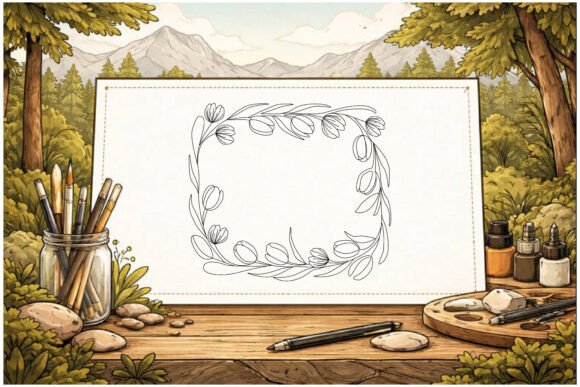
Elegant Tulips for Modern Creators
There is a specific kind of visual calm that comes from single-line illustration. When you strip away complex shading and heavy textures, you are left with the pure gesture of the subject. That is exactly the power behind the Decorative Tulip Border Line Art. It captures the organic, curving form of a tulip using a continuous, clean stroke. It feels organic, modern, and surprisingly versatile. For designers and creators, this asset solves a common problem: how to add natural elegance to a project without overwhelming the composition. It works as a standalone focal point or as a subtle, repeating frame that anchors your layout.
The Anatomy of a Modern Design Asset
Visually, this style relies on negative space. By using a "one line" aesthetic, the design feels light and airy. It does not scream for attention; rather, it invites the viewer to look closer. This makes the Decorative Tulip Border Line Art an exceptional piece of modern typography and illustration. While it is not a traditional typeface, it functions much like a creative font in terms of setting a mood. It bridges the gap between fine art and graphic design. The personality here is sophisticated yet approachable. It avoids the stiffness of rigid corporate graphics, offering instead a human touch that feels hand-drawn but digitally perfected.
Because the files are provided in high-quality vector formats (EPS and SVG), you have total control. You are not locked into a specific color palette. If your brand identity is built on deep navy blues and crisp whites, you can adapt this art to match. If you are designing for a spring collection using pastels, the vector lines will scale perfectly without losing clarity. This flexibility is crucial for maintaining brand consistency across different mediums, from web design to physical merchandise.
Practical Applications for Print and Digital Media
The true value of a design asset lies in its utility. Where does Decorative Tulip Border Line Art actually fit into your workflow? The short answer is: almost everywhere. However, the application changes the context.
For print-on-demand entrepreneurs, this design is a goldmine for apparel and accessories. Minimalist art prints exceptionally well on tote bags and t-shirts because it avoids the "heavy ink" feel that can make clothing uncomfortable. On a mug, the line art provides a clean, boutique look that feels premium. It transforms a generic ceramic cup into a piece of home decor. Similarly, for pillow designs, the single-line style adds texture without cluttering a living room aesthetic.
For publishers and editorial designers, think about the hierarchy of your pages. This art works beautifully as a border for wedding invitations, book covers, or magazine headers. In editorial design, whitespace is a tool. Using a delicate border allows you to frame text blocks or photographs, guiding the reader's eye without distracting from the content. It acts as a visual container that says, "Look inside this space."
Digital creators and marketers can leverage this asset for social media graphics. A static Instagram post can often feel flat. Adding a subtle tulip border creates depth and framing. It is also excellent for website headers or blog post featured images, particularly for niches related to lifestyle, wellness, gardening, or fashion. Because the file is 100% scalable, it looks just as sharp on a 4K monitor as it does on a mobile screen.
Integrating Art into Your Brand Strategy
Choosing a visual asset is a strategic decision, not just an aesthetic one. When you incorporate Decorative Tulip Border Line Art into your branding, you are signaling specific values. Tulips often symbolize renewal, spring, and elegance. By using this motif, you align your brand with those feelings.
Consider the psychology of your audience. Adults aged 20 to 50, particularly those interested in design and home decor, often gravitate toward "clean" and "minimal" aesthetics. They appreciate design that respects their intelligence and doesn't rely on loud colors or chaotic layouts. This line art fits perfectly into that preference. It suggests that your brand is curated, thoughtful, and pays attention to detail.
File Formats and Workflow Efficiency
One of the biggest hurdles in creative work is file compatibility. Nothing slows down a project like a file that won't open or a graphic that pixelates when resized. This package addresses that by including the industry standards: EPS, SVG, and JPEG.
- Vector Files (EPS & SVG): These are your workhorses. They are fully editable in software like Adobe Illustrator, Affinity Designer, or Inkscape. You can change the stroke weight, alter the color, or rearrange the elements of the border to fit a specific aspect ratio.
- High-Resolution JPEG: At 300 DPI, these are ready for immediate printing. If you are using a program that struggles with vectors (like certain basic photo editors), the JPEG ensures you still have a crisp image.
- Cutting Machines: For those using Cricut or Silhouette, the SVG format is particularly vital. It allows the machine to read the lines perfectly, ensuring a clean cut for stickers or vinyl decals.
Design Observations and Pairings
When working with Decorative Tulip Border Line Art, font pairing is key. Because the art is delicate and flowing, you want to choose typography that complements it rather than competes with it.
I recommend pairing this line art with a clean sans serif font for body text. Fonts like Montserrat, Lato, or Helvetica provide a stable, modern foundation that lets the organic lines of the tulips stand out. For headers or accent text, a modern serif font (like Playfair Display or Bodoni) can add a touch of classic sophistication that matches the floral theme.
Avoid pairing this design with heavy, distressed fonts or overly complex script fonts. The goal is to maintain readability. The line art provides the "art" element; your typography should provide the "information" element. When these two things work in harmony, the result is a professional layout that feels cohesive and intentional.
A Final Note on Scalability
Scalability is the unsung hero of digital assets. Whether you are printing a small sticker for a planner or a large canvas wall art piece for a living room, the vector nature of this file ensures the lines remain smooth. There is no jaggedness or blurring. This level of quality is non-negotiable for professional commercial use. It ensures that your final product—whether physical or digital—always looks polished.
Ultimately, the Decorative Tulip Border Line Art is more than just a graphic. It is a tool for framing your content, elevating your brand identity, and adding a touch of nature-inspired elegance to your creative projects.